

By Monterey Bud
A recent study conducted by scientists at the University of British Columbia (UBC) has unmasked more than two-dozen genes that provide the cannabis plant it’s varied flavor profile.
Published Thursday in the PLOS ONE journal, the study is part of an ongoing collaboration between researchers at UBC and Anandia Labs.
Investigating the various genes responsible for instilling our favorite strains with their distinct essence, UBC scientists have begun examining how specific terpenes and cannabinoid compounds interact to create today’s appetizing strains, according to a press release from UBC:
“The goal is to develop well-defined and highly-reproducible cannabis varieties. This is similar to the wine industry, which depends on defined varieties such as chardonnay or merlot for high-value products,” said Jörg Bohlmann, a professor in the Michael Smith Laboratories and faculty of forestry at UBC. “Our genomics work can inform breeders of commercial varieties which genes to pay attention to for specific flavor qualities.”
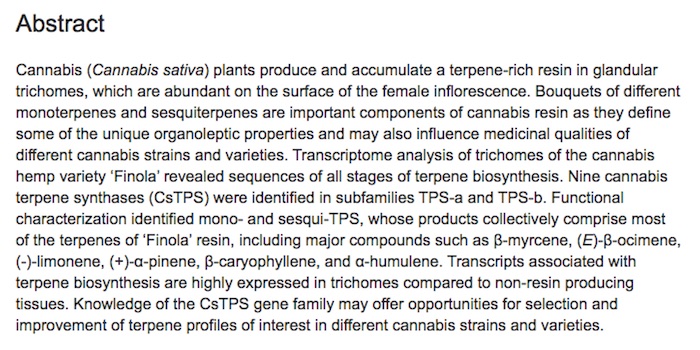
PLOS ONE Study: Terpene Research
From limonene to myrcene, the researchers discovered approximately 30 terpene synthase genes that significantly contribute to today’s “diverse flavors in cannabis.” Analogous to the wine industry and the genes that dictate their product’s flavor profile, “The genes the researchers discovered play a role in producing natural products like limonene, myrcene, and pinene in the cannabis plants.”
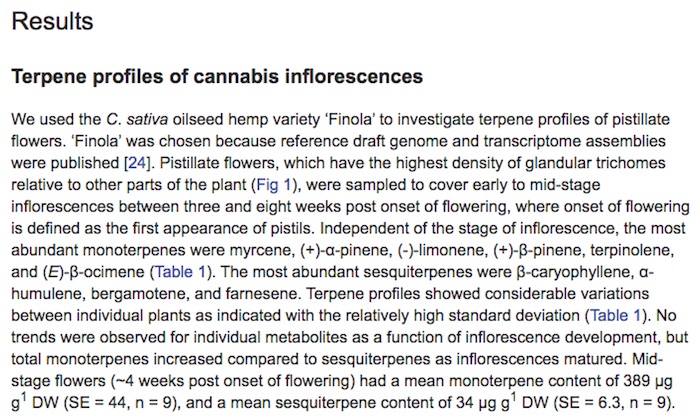
Terpene Research Results
Through this research, scientists hope to gain a greater understanding of how to cultivate “well-defined and highly reproducible cannabis varieties,” in addition to learning more about the synergistic interplay that confers the plant’s “medicinal properties.”
